


Kew Orchids China Exhibition

What does it take to create a showstopping display of orchids? Solène Dequiret and the team at Kew Gardens know. With 30 years of experience in orchid exhibitions, Kew’s biggest challenge is continuously bringing a fresh angle to this annual floral festival. Thankfully, between the horticulturists, visitor programming team, and commissioned artists, creativity isn’t in short supply. From nylon stockings to flowery fingernails, find out why Kew’s Orchids China Festival is worth visiting this February.
An intuitive collaboration of skill, artistry and horticultural genius, the ‘Orchids China’ display is situated throughout the Princess of Wales Conservatory’s permanent collections. Over 3400 individual orchids form floral columns, decorative arches and symbolic animals from Chinese culture. From a distance, the animals look like they’re made from an ancient form of papyrus paper, but up close, it’s possible to discern the individual dried leaves that make up the arrangements. Each botanical element has been carefully saved and preserved from Kew’s tropical plant collection.
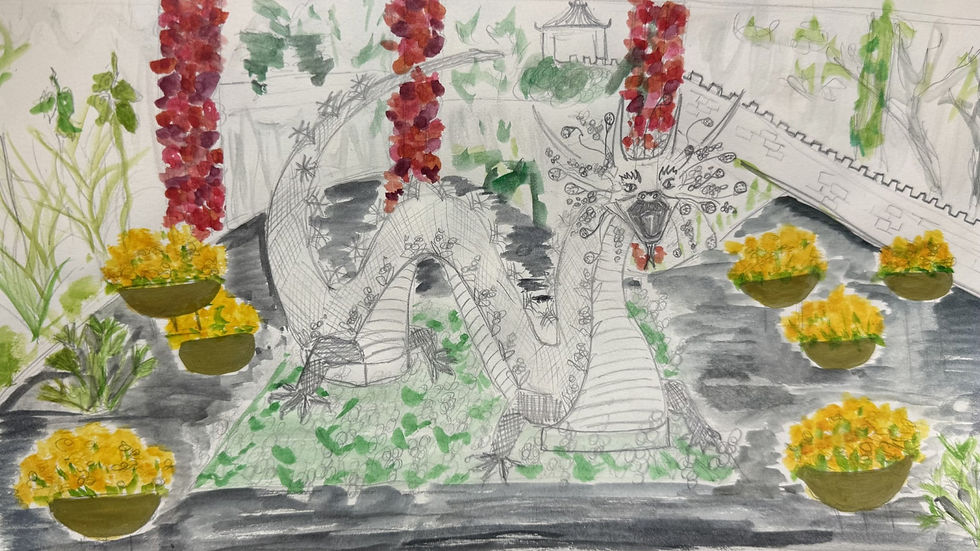
The leaves give life to the animal figures, of which Orchids China’s central exhibit is a dragon, guarding a floating platform in the largest pond. Surrounded by floral yellow bowls that spill forth with phalaenopsis orchids, the dragon and his ‘money pots’ symbolise prosperity and good fortune in Chinese culture. Scales are exchanged for petals, with an array of beautifully arranged phalaenopsis orchids decorating his spine. With an alocasia leaf for a tongue, inflorescences (flowers) for claws, and sarracenias for tail spikes, the dragon safeguards the living collections that surround him. To finish off, this imperial dragon is crowned with a floral coronet that explodes into an extravagant display of tiny Cymbidium orchid petals.

With China’s biodiversity being infamous in the botanical world, it’s not surprising that of 28,000 globally known orchid varieties, 1710 are native to China. With phalaenopsis and cymbidium orchids being the most abundant to China, and, being widely available commercially, they feature heavily in the exhibit. Accompanied by different types of anthuriums, alocasias and the occasional colourful stromanthe triostar, the displays are made up from carefully selected plants that are readily available to consumers. It just goes to show that a little bit of imagination can go a long way!
Someone exceedingly passionate about the living collections and concept is the Princess of Wales Conservatory Manager, Solène Dequiret. She explained that the botanical team who worked on the installation have a diverse range of skills from floristry to crafting. The design merges horticultural techniques with intuitive display methods. As there’s little time to naturalise new orchids in their temporary home, the team must find ways to attach them to tree branches. Afterall, these naturally epiphytic plants grow in the wild by wrapping their roots around trunks for security. In the past, Solène said they used nylon tights to tie orchids to branches, but now they’re able to do without your grandmother’s old stockings, using nylon elastic instead!
Bundles of moss keep display plants moist during the festival, and everything is watered before it’s moved into position. Therefore, the botanical displays can mostly self-sustain for the month the festival is open to the public, with plants possibly watered only 1-2 times in the exhibition’s duration. However, Solène explained this is dependent on the temperatures and environmental conditions.
Once everything is in situ, not a single plant will be swapped out. The tropical glasshouse team have to be especially careful not to overwater anything, or the orchids will go over too quickly. We all know that watering indoor plants is an art, and these horticulturalists need to be at the top of their game to keep Kew China’s orchids blooming.

From conception to installation, the process of curating the orchid festival can take an entire year. Every step of the way, the Princess of Wales Conservatory team are supported by Visitor Programming. Mark Godber, Visitor Programmes Manager, assisted with sourcing artists, such as the ecologically inspired artist Zheng Bo, and the Chinese heritage of Kew’s team was called upon for contribution.
Armed with Solène’s brief, the orchid festival developed with the collections at its heart, and special acknowledgement of Kew’s scientific research programmes. For Orchids China, the use of plants in Chinese Medicine was a central idea, and visitors can find out more in the permanent orchid display room, which contains a cabinet of several curiosities.
‘Orchids China’ may have taken one year to put together, but it’s only available to see for one month. You’re probably wondering what happens when it all comes down, too. Well, the orchids go to volunteers who participated in the installation, from the planting to the workshopping of lanterns. The orchids that can’t be sold are donated to charities, bringing more botanical joy to communities who can’t make it to Kew’s festival. And for Solène and the team? March 2026 is when they start doing it all again.
Visit Orchids China Festival at Kew Gardens between Saturday 7th February and Sunday 8th March inclusive 2026. Entry is by pre-booked slot and is permitted by general ticket purchase to Kew Gardens.




Comments